How Crypto Payment Infrastructure Should Truly Work
In many crypto projects, Web2 platforms, and Web2 to Web3 integrations, accepting deposits is not the real challenge. The real challenge is:
- ▸Who should control the funds?
- ▸Who holds the private keys?
- ▸Should developers touch customer assets?
- ▸If something goes wrong, how much is lost?
Below, let's clearly compare the traditional method (without WARMKEY) vs. the WARMKEY architecture, and explain the pain points WARMKEY is designed to solve.

1. Traditional Method (Without WARMKEY)
High Risk, Low Efficiency
Developer Side: Private Keys in Backend
In traditional crypto payment setups, to achieve the following:
- •One Deposit Address per User
- •Automated Address Generation
- •On-chain Deposit Tracking
Developers typically must:
- •Store private keys or mnemonic phrases
- •Generate deposit addresses from backend scripts
- •Control hot wallets on the server
This creates the first and most critical risk:
Even if developers are trustworthy, risks remain:
- ✕Internal Abuse
- ✕Server Compromise
- ✕Malware or Infected Machines
If private keys are leaked, ALL deposited funds are at risk, not just a portion.
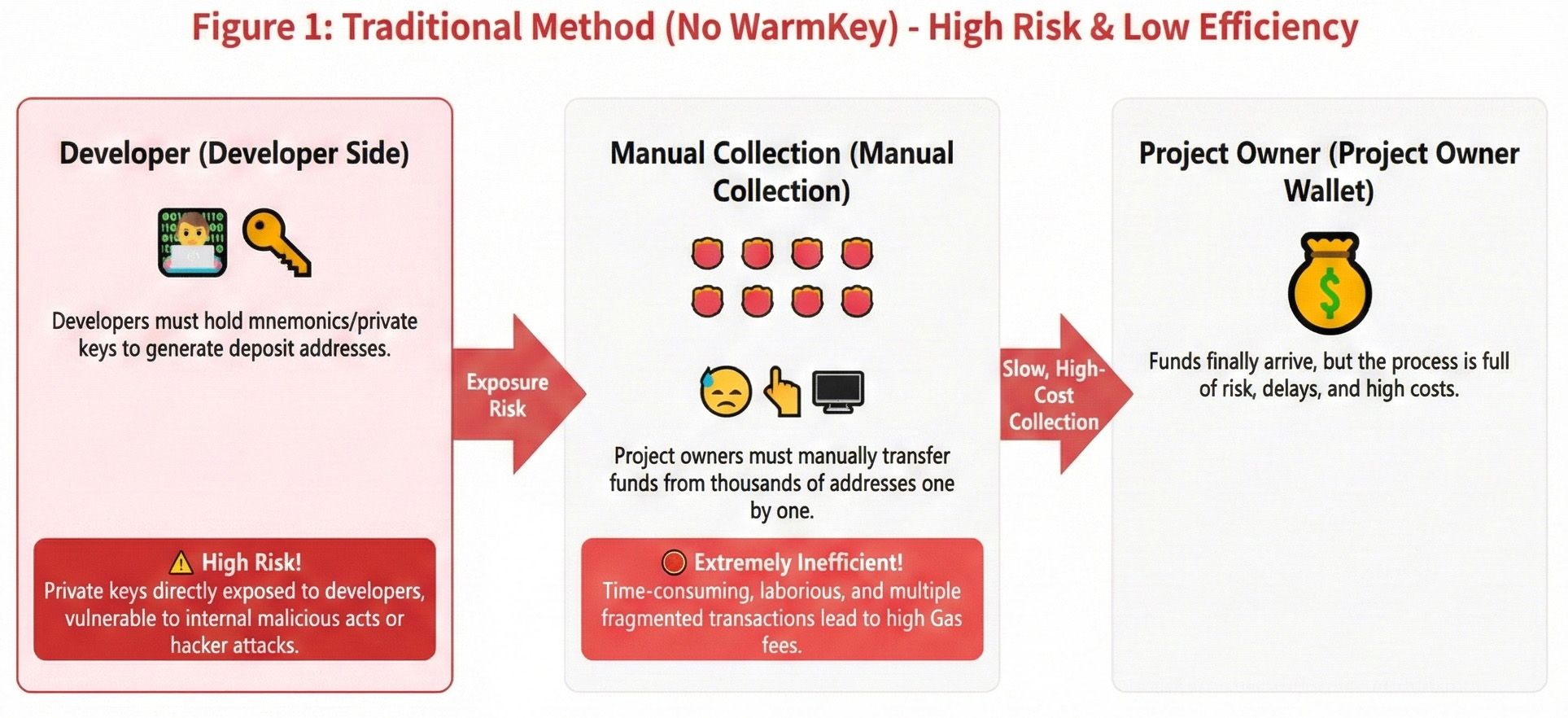
Manual Sweeping: An Operational Nightmare
As deposits increase, funds are scattered across:
- •Hundreds or thousands of user deposit addresses
- •Multiple time windows and transactions
To sweep funds, the project team must rely on:
- •Manual Sweeping
- •Frequent Signing
- •Repetitive Transaction Approvals
This leads to:
- ❌Low Operational Efficiency
- ❌High Human Error Rate
- ❌Expensive Gas Fees
- ❌Heavy Operational Burden
Project Team Wallet: Funds Arrive, But at a High Cost
Yes, the funds eventually reach the project team's wallet.
But the process involves:
2. WARMKEY Architecture
Secure, Automated, and Efficient
Developer Side: True Security Isolation
With WARMKEY:
- ✓Developers only use API Keys
- ✓APIs CAN: Generate deposit addresses, query status
- ✕APIs CANNOT: Sign transactions, move funds, withdraw assets
- NEVER enter backend scripts
- NEVER touch the server
- NEVER accessible by developers
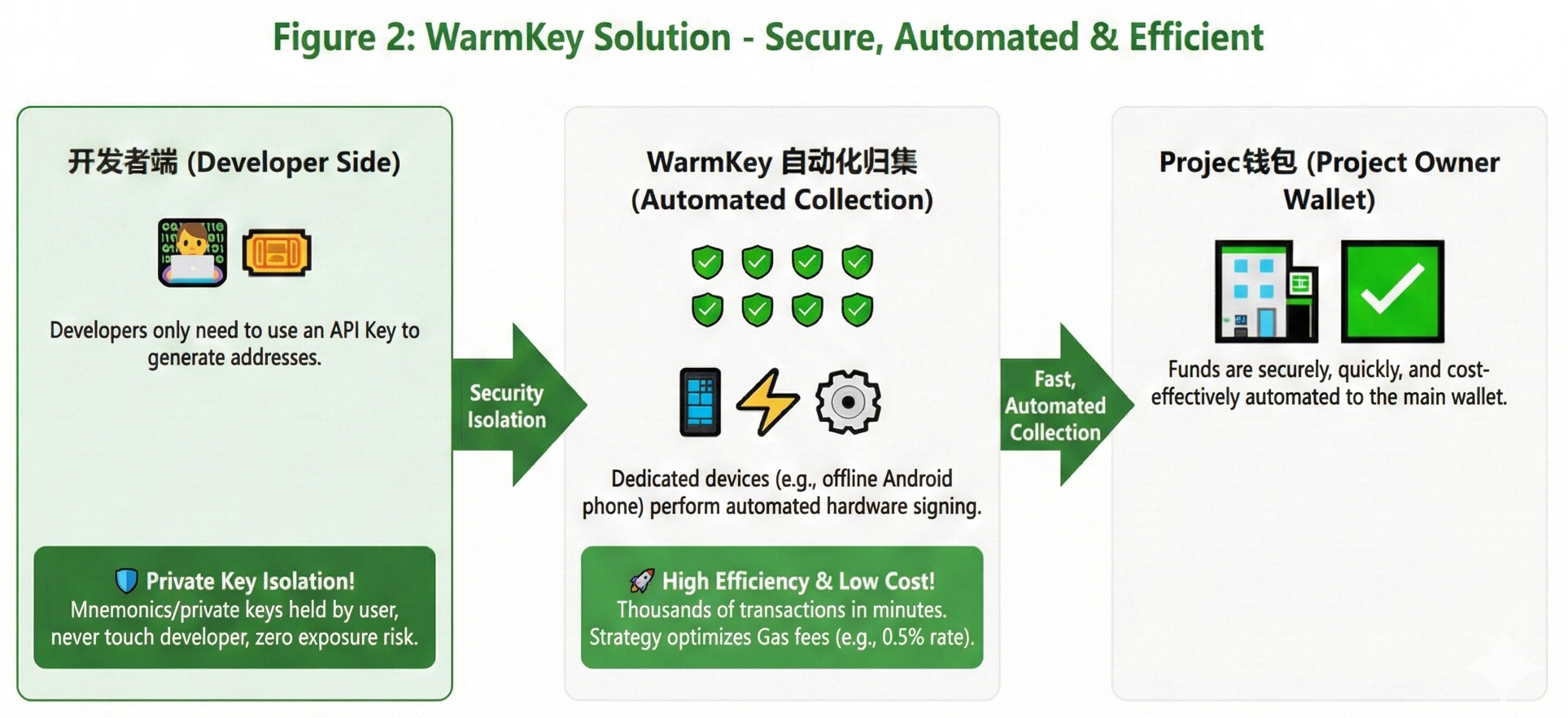
WARMKEY Auto-Sweeping: Policy-Based Signing
WARMKEY doesn't rely on blind automated signing.
Instead, it uses policy-based signing, executed by a dedicated user-controlled device (e.g., Android phone).
Signing policies might include: Withdrawal Limits, Allowed Target Addresses, Sweep-Only Permissions
This ensures:
- ✅Unattended Automation
- ✅No Repetitive Manual Signing
- ✅No Blind or Unlimited Approvals
Funds are only swept under predefined rules.
Fast, Secure, and Controlled
- •Funds are automatically swept
- •Assets remain under owner's control
- •Risk exposure capped by predefined limits
Even in the worst-case scenario:
- •Only the pre-approved rolling amount is exposed
- •User deposits are protected
3. Pain Points Solved by WARMKEY
Final Comparison
Without WARMKEY
- - Developers handle sensitive assets
- - Manual operations dominate
- - High systemic risk
With WARMKEY
- - Developers focus on building
- - Assets remain with the owner
- - Operations run automatically
Conclusion
WARMKEY is not just another crypto payment gateway.
It is a redesign of infrastructure that separates:
Code from Funds | Automation from Custody | Efficiency from Risk