





How Crypto Payment Infrastructure Should Really Work
In many crypto projects, Web2 platforms, and Web2-to-Web3 integrations, accepting deposits is not the real challenge.
The real challenges are:
- Who should control the funds?
- Who holds the private keys?
- Should developers ever touch client assets?
- If something goes wrong, how much can be lost?

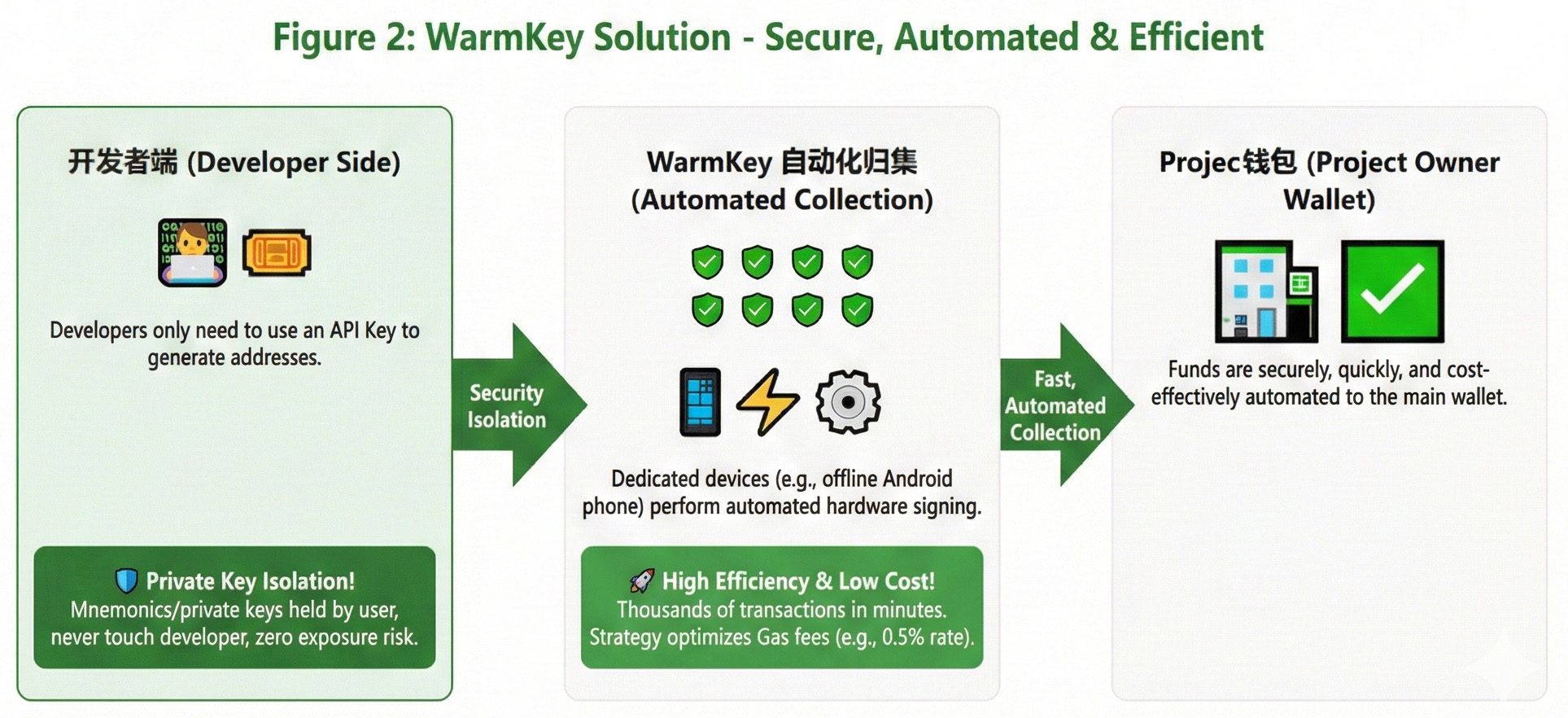
Using the diagrams above, let’s clearly compare the traditional approach (without WARMKEY) and the WARMKEY architecture, and explain the pain points WARMKEY is designed to solve.
1. Traditional Approach (Without WARMKEY)
High Risk, Low Efficiency
Developer Side: Private Keys in the Backend
In a traditional crypto payment setup, to implement features like:
- One-user-one-deposit address
- Automated address generation
- On-chain deposit tracking
Developers usually have to:
- Store private keys or mnemonic phrases
- Generate deposit addresses from backend scripts
- Control hot wallets on servers
This creates the first and most critical risk:
Whoever holds the private key ultimately controls the funds.
Even with trustworthy developers, risks still exist:
- Internal misuse
- Server breaches
- Malware or compromised machines
If private keys are exposed, all deposited funds are at risk, not just a portion.
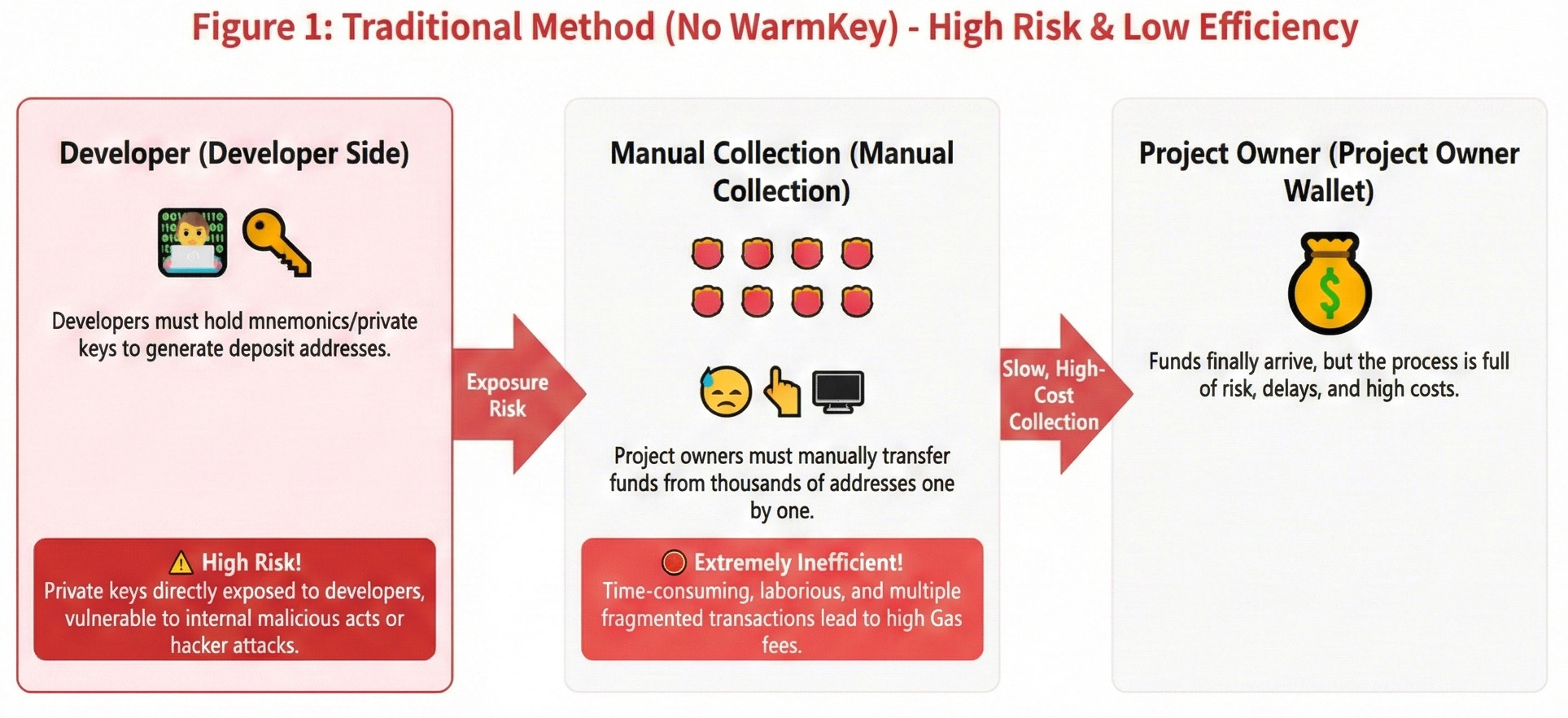
Manual Collection: Operational Nightmare
As deposits increase, funds become scattered across:
- Hundreds or thousands of user deposit addresses
- Multiple time windows and transactions
To consolidate funds, project owners must rely on:
- Manual collection
- Frequent signing
- Repetitive transaction approvals
This leads to:
- ❌ Low operational efficiency
- ❌ High human error rate
- ❌ Expensive gas costs
- ❌ Heavy operational burden
Many teams eventually realize:
“Our system is automated, but our money flow is still manual.”
Project Owner Wallet: Funds Arrive, but at a Cost
Yes, funds eventually reach the project owner’s wallet.
But the process involves:
- High risk
- Delays
- Operational fatigue
- Constant anxiety
The fundamental problem is clear:
Security, efficiency, and control cannot coexist in this model.
2. WARMKEY Architecture
Secure, Automated, and Efficient
WARMKEY was designed with one simple principle:
Developers should never touch private keys or client funds — yet automation must remain.
Developer Side: True Security Isolation
With WARMKEY:
- Developers only use API keys
- APIs can:
- Generate deposit addresses
- Query deposit and withdrawal status
- APIs cannot:
- Sign transactions
- Move funds
- Withdraw assets
Private keys and mnemonics:
- Never enter backend scripts
- Never touch servers
- Never become accessible to developers
This creates true role separation.
Even if a developer is compromised, assets remain safe.
WARMKEY Automated Collection: Policy-Based Signing
WARMKEY does not rely on blind auto-signing.
Instead, it uses policy-based signing, executed by a dedicated user-controlled device (such as an Android phone).
Signing policies may include:
- Withdrawal limits
- Allowed destination addresses
- Collection-only permissions
This ensures:
- Automation without human intervention
- No repetitive manual signing
- No blind or unrestricted approvals
Funds are consolidated only under predefined rules.
Project Owner Wallet: Fast, Safe, and Controlled
The outcome:
- Funds are automatically collected
- Assets remain under the owner’s control
- Risk exposure is capped by predefined limits
Even in worst-case scenarios:
- Only the pre-approved rolling amount is exposed
- User deposits remain protected
This reflects WARMKEY’s core philosophy:
Never place all assets at risk at once.
3. Pain Points Solved by WARMKEY
✅ Trust Elimination
Developers do not need to be trusted — they simply lack access.
✅ Private Key Security
Keys never enter backend infrastructure.
✅ Operational Efficiency
No manual collection. No repetitive signing.
✅ Lower Gas Costs
Optimized batch processing reduces fees (≈ 0.5%).
✅ Risk Containment
Loss exposure is limited to user-defined amounts.
Final Comparison |
|
|---|---|
Without WARMKEY |
With WARMKEY |
|
|
Conclusion
WARMKEY is not just another crypto payment gateway.
It is an infrastructure redesign that separates:
- Code from money
- Automation from custody
- Efficiency from risk
Developers build. Owners control. Funds stay safe.